Why can't you take pictures of Guernica?
The ban on photographing Guernica ended in September 2023. What the rule was, why it lasted for decades, and why so many people still think it applies.
 By Elena García, Madrid Museums Specialist & Cultural Guide
For years the sound in front of Guernica was a guard saying no, over and over, in three languages. People raised phones anyway, got waved down, and the room stayed a strange island of enforcement inside a museum where photography was fine everywhere else. That rule changed back in September 2023, so the question most people are still asking has an out-of-date premise.
Why can't you take photos of Guernica?
You can, and have been able to since September 2023, as long as you do not use flash. The Reina Sofía lifted its long-standing ban under director Manuel Segade that month, and photography without flash has been permitted ever since. The old rule existed for conservation, crowd control and the painting's security history, and it was enforced by staff standing in the room all day.
Each of those three reasons carried real weight. Flash is bad for pigment over time, which is why no serious museum allows it near a painting of this age. A single canvas that every visitor wants a picture of also creates a bottleneck, and Guernica's room was the worst pinch point in the building on a free evening. The security argument was the oldest of the three, and it goes back to how the painting arrived.
The museum's stated reason for the change was to stop guards spending their shifts policing phones and let the room behave like the rest of the collection. The museum's own visitor pages carry the current rules, and our guide to where Guernica hangs and how the room works covers the practical side, including which entrance puts you closest.
The change is nearly three years old, yet plenty of blog posts, printed guidebooks and even a few tour scripts still tell you the room is off limits to cameras. Here is how the rule actually moved.
| When | What applied to Guernica |
|---|---|
| September 1981 | Arrived in Madrid under escort and went on show in the Casón del Buen Retiro behind bulletproof glass |
| 1992 | Moved to the Reina Sofía when it opened as Spain's national museum of twentieth-century art |
| Until 2023 | Photography banned in the room, enforced by guards, with occasional exceptions |
| Since September 2023 | Photography without flash permitted, under a policy change by the museum's director |
What is the story behind Guernica by Picasso?
Picasso painted it in 1937, after the bombing of the Basque town whose name it carries. The canvas spent decades outside Spain and only reached Madrid on 10 September 1981, arriving under escort and going on display behind bulletproof glass. It moved into the Reina Sofía in 1992 and has stayed there since.
That journey explains the protective instinct around it. A painting that came home as a political event, then spent its first Madrid years behind armoured glass in a guarded room, does not shed those habits quickly. The glass came off, the museum grew around it, and the no-photography rule was the last piece of that older posture still standing.
It hangs in Room 205.10 on Floor 2 of the Sabatini building, on its own long wall, and the museum has built a dialogue around it: the Dumile Feni show subtitled African Guernica ran in the collection through September 2026. If seeing it is your reason for the trip, book the Reina Sofía's timed entry for a morning and check availability for your dates, because free evening slots are the busiest hours in the building. Whether the rest of the collection deserves a full afternoon is a separate question, and we answer it in our verdict on the Reina Sofía.
Why can't you take pictures at Prado?
The Prado does not allow photography of its collection, and that rule has not changed. The reasons museums give are conservation of light-sensitive works, the flow of people through narrow galleries, and reproduction rights on loans and temporary shows. Rules differ from museum to museum in Madrid, so check each one rather than assuming.
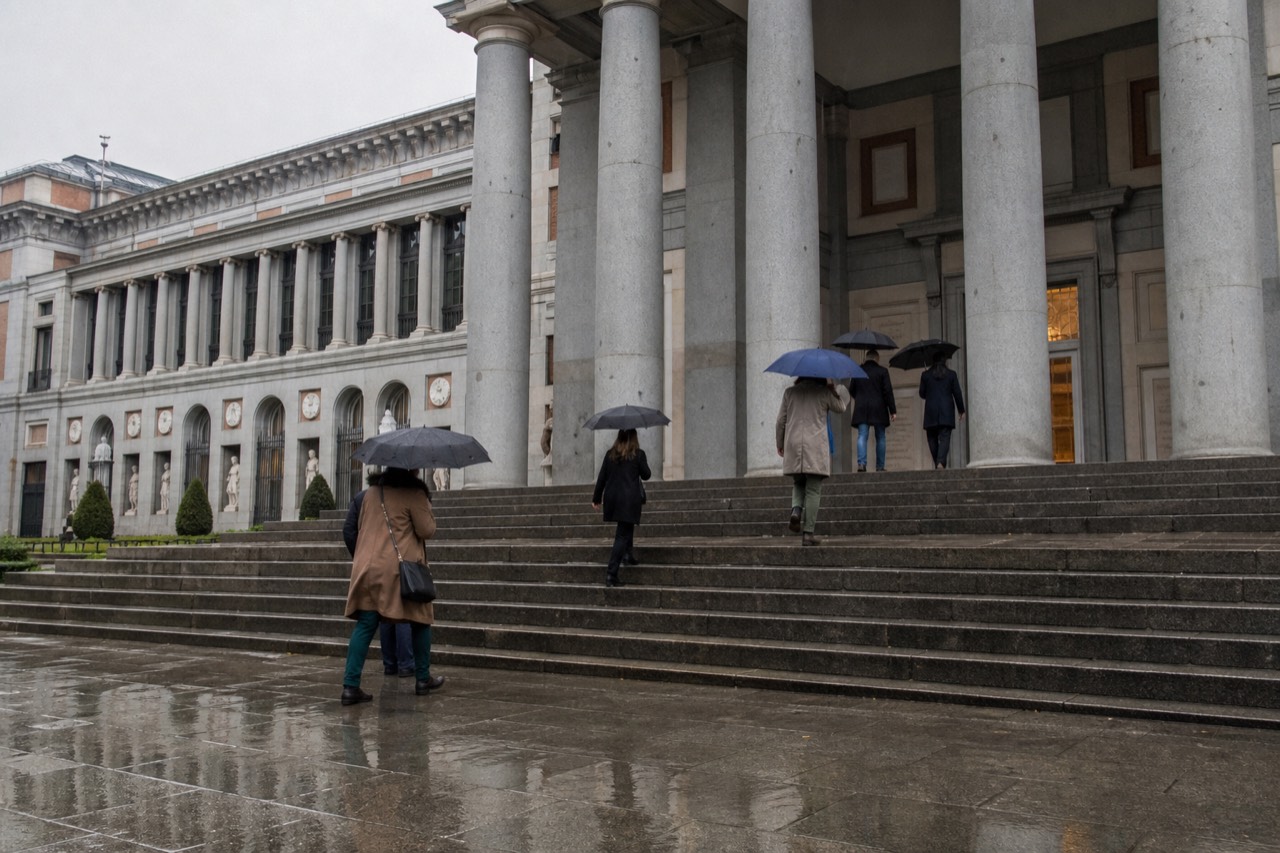
This is the part that trips people up. Two museums a ten-minute walk apart on the same boulevard now run opposite policies, and the more famous one is the stricter. Before you plan a photo of Las Meninas on the Prado's ticketed entry, read the Prado's visitor information, and treat any exhibition space as tighter again, since loans usually carry their own conditions. Details for both sit alongside every other collection in the city in the madrid museums directory.
What else do people ask about photographing Guernica?
The follow-up questions are about flash, tripods, video and the other rooms in the museum. The short answer is that the change is narrow: it permits ordinary phone photographs without flash in one room, and it does not turn the Reina Sofía into a free-for-all.
Can you use flash in front of Guernica?
No. Flash stays banned, and that is the one condition attached to the new rule. Turn it off before you go into the room rather than trusting your phone to decide, because automatic modes fire in low light without asking.
Was photographing Guernica ever allowed before 2023?
Not in general. The ban was close to absolute for years, with occasional exceptions granted to particular visitors, which is exactly the inconsistency the museum cited when it changed the policy.
Which room is Guernica in?
Room 205.10, on Floor 2 of the Sabatini building. Some older guides list adjacent numbers because the collection has been rehung more than once. Follow the signs from the main hall and the flow of people, which is unmistakable.
Where else in Madrid can you see Picasso?
Almost entirely at the Reina Sofía, which holds the national modern collection. Our piece on which Madrid museum holds Picasso sets out what is where, including why the Prado is not the answer.