Opens the museum's own website. Book on the official site; nothing is charged on this page.
Area
Madrid
Theme
Science & family
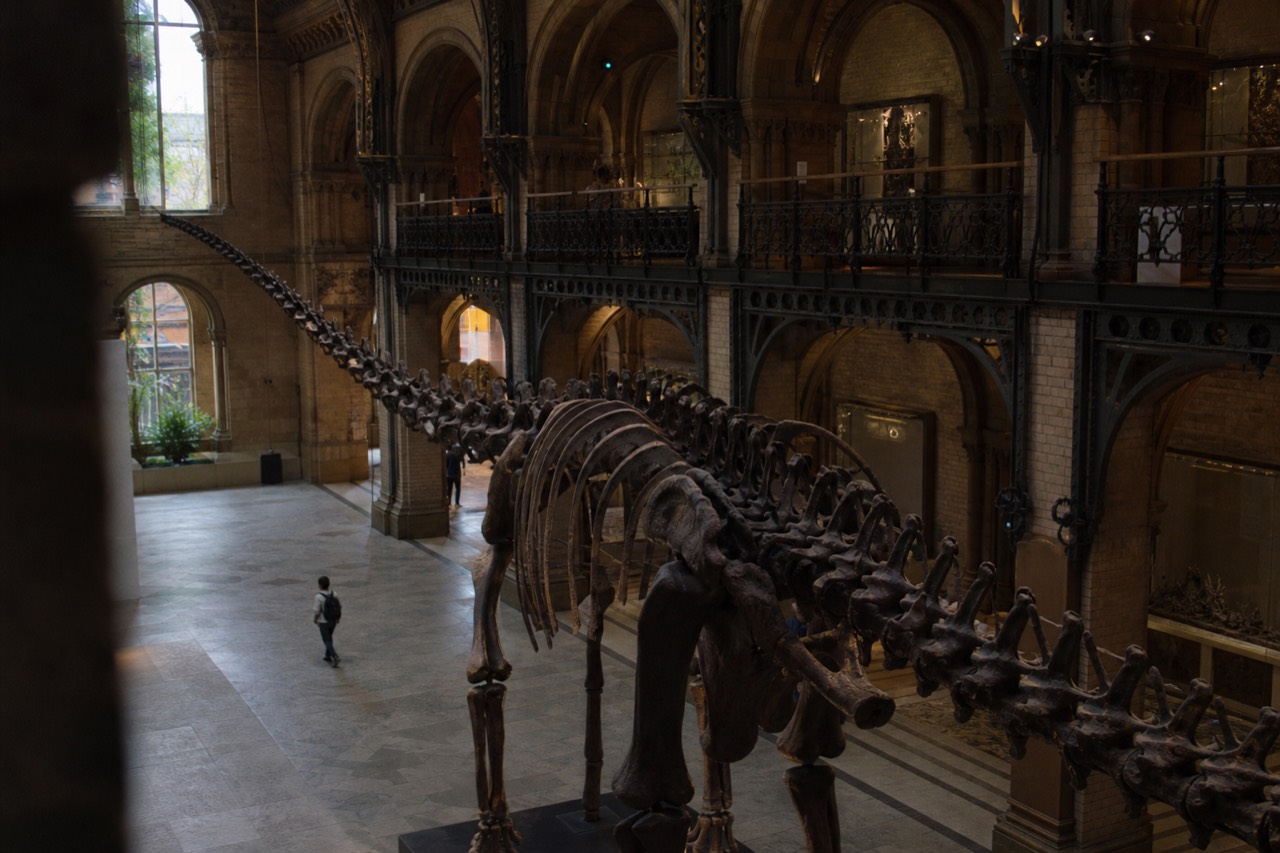
A giant ground sloth rears up on its hind legs in the fossil hall, one of the oldest mounted skeletons of its kind anywhere, dug out of a South American riverbank and shipped across the Atlantic to a Spanish king. A cast of a Diplodocus stretches its neck and tail not far away. The Museo Nacional de Ciencias Naturales is Spain's national natural history collection, run by the CSIC research council, and it spreads across two buildings on the Paseo de la Castellana. Admission is seven euros, and Sunday evenings are free.
What will you see inside the Natural Sciences Museum?
Two buildings on one site: the first holds biodiversity and fossils, mounted animals, skeletons and evolution; the second carries geology, minerals and meteorites. The pieces children remember are the giant ground sloth, put together long before the word dinosaur existed, and the Diplodocus cast. One ticket covers everything.
The fossil hall is where a visit finds its centre. The ground sloth came out of the ground in South America and was mounted here in Madrid at a time when nobody had a word for what it was, which makes it a piece of scientific history as much as a skeleton. Around it sit the bones of animals that no longer exist, arranged so the shapes do the explaining.
The biodiversity displays work on scale and detail at once. Big mammals stand mounted in mid-stride, birds fill case after case, and the small things, insects, shells, eggs, are laid out in the obsessive rows that only a research collection produces. It is a museum that counts and classifies rather than one that stages a spectacle.
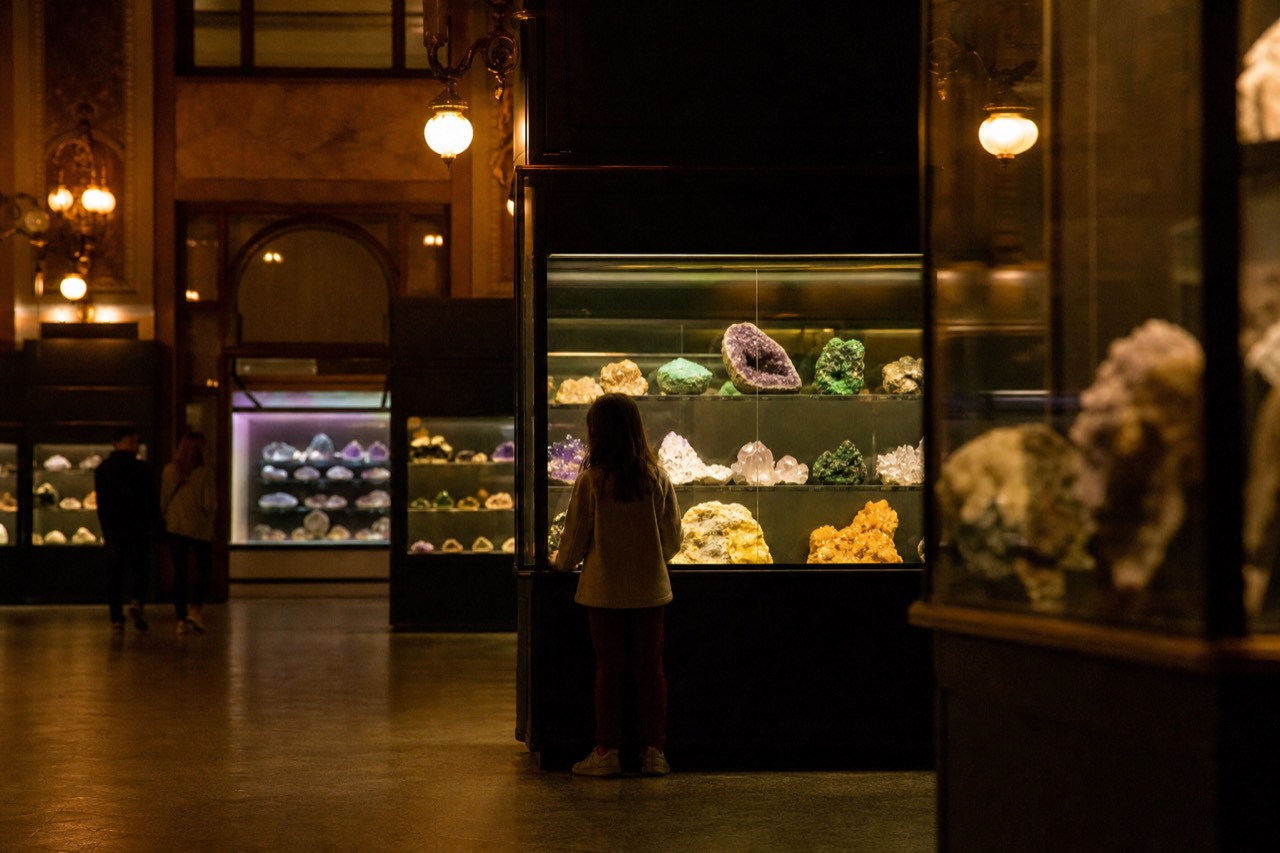
Cross to geology and the material changes completely: minerals split open to show their colour, crystals the size of a fist, meteorites that fell out of the sky and were catalogued afterwards. This half of the museum gets skipped by tired families and is worth ten minutes even then.
Keep in mind what this place is. The CSIC runs it as a working research institute, so the labels are serious, the collections are study collections, and the tone is closer to a university than a theme park. Temporary exhibitions rotate through the year alongside the permanent halls, and the current list sits on the official site.
How do tickets work, and when is entry free?
General admission is €7 and covers both buildings. Entry is free every Sunday from 17:00 to 20:00, the last three hours of the day. The museum closes on Mondays, except when a Monday falls on a public holiday, and also on 1 and 6 January, 1 May and 25 December.
The Sunday window is genuinely free and genuinely popular, because three hours on a Sunday evening is exactly when families in the city are looking for something indoors. It buys the same access a paid ticket does. What it does not buy is elbow room, and three hours is a shorter run at the museum than it sounds once coats and children are involved.
Paying is not a hard call at this price. Seven euros for two buildings puts it among the better-value tickets in the city, and a weekday visit lands you in halls where a child can stand in front of a skeleton without queueing for the view. Reduced rates apply to set categories, listed with the current hours and the location on the museum's own visitor page.
Ticket
Price
Notes
General admission
€7
Covers both buildings on the site
Free window, Sunday
Free, 17:00 to 20:00
Same access, no ticket purchase
Reduced admission
Set categories
Conditions on the official site
Closed
Mondays
Except public holidays; also 1 and 6 January, 1 May, 25 December
Set against the city's other days out with children, it prices low and stays indoors, which is the combination that matters in August and in February.
Where
What it is
Admission
Free entry
Museo Nacional de Ciencias Naturales
Skeletons, mounted animals, minerals
€7
Sundays 17:00 to 20:00
Museo del Ferrocarril
Locomotives inside a 19th-century station hall
Price on the museum's own site
None published
Zoo Aquarium Madrid
Animals and an aquarium in the Casa de Campo
Live price on the listing
None
Parque de Atracciones
Rides and shows in the Casa de Campo
Live price on the listing
None
How long do you need, and does it work with children?
Ninety minutes suits most families, and two hours covers both buildings without rushing. Younger children run out of attention before adults do, so take the big skeletons first and treat geology as the optional second half. The whole visit stays indoors, which matters in a Madrid August.
A route that works with children: fossils first, while everyone is fresh and the biggest things in the museum are still a surprise. Then the biodiversity cases, which reward wandering more than reading. Then, if patience holds, the minerals across the way, where the colours do the job the labels cannot.
Adults visiting alone can go slower and get more out of it. The collections were built for research, so the labelling repays attention, and the evolution material is arranged as an argument rather than a parade. Two hours is comfortable, and three is possible if a temporary exhibition is running.
One honest note on expectations. This is a classical natural history museum: cases, skeletons, taxidermy, printed labels. Families arriving from an immersive attraction sometimes expect screens and buttons and find fewer than they hoped. What it offers instead is real material, at real scale, for the price of a sandwich.
Know before you go: hours, the Monday closure and getting there
The museum sits on the Paseo de la Castellana, north of the city centre, with its collections split between two buildings on the same site. Admission is €7, free on Sundays from 17:00 to 20:00, and it closes on Mondays unless the Monday is a public holiday. Current hours are published officially.
Getting there is straightforward from anywhere along the Castellana, the long avenue that runs north out of the centre, and the museum is signposted from the street. Anyone staying near the Art Walk has a longer trip than the walk to the Prado, but a simple one, and the surrounding district is business Madrid rather than tourist Madrid.
Two things to check before you set out. Public holidays override the Monday closure in both directions, so the calendar on the official site is the reliable version. And the two buildings keep the same hours but are entered separately, so leave a few minutes to move between them rather than discovering geology with ten minutes left.
At a glance
Detail
Where
Paseo de la Castellana, north of the city centre
Layout
Two buildings on one site, both covered by the same ticket
Adult admission
€7
Free entry
Sundays 17:00 to 20:00
Closed
Mondays, except public holidays; 1 and 6 January, 1 May, 25 December
Run by
The CSIC research council
Time to allow
90 minutes to two hours
Star pieces
The giant ground sloth and the Diplodocus cast
What can you pair with the Natural Sciences Museum?
The natural pairing is the Casa de Campo pair on the other side of the city, the zoo and the amusement park, which turn a museum morning into a full family day. Indoors, the Railway Museum is the closest match in spirit. The National Archaeological Museum is the nearest serious collection to this one.
For a second dose of large things at close range, the Railway Museum parks its locomotives inside a 19th-century station hall, and it works on the same children for the same reasons. Both are indoor stops, which makes them the obvious pair on a wet weekend or a punishing summer afternoon.
If the animals are the draw rather than the skeletons, Zoo Aquarium Madrid and the Parque de Atracciones sit side by side in the Casa de Campo and make an easy full day between them. Neither is a museum, and both are a different kind of tired by the end.
Adults with an hour left over should walk south to the National Archaeological Museum on Calle Serrano, three euros for the Lady of Elche and Spanish archaeology from prehistory onwards; its hours and free windows are published on the museum's own site.
Questions people ask
How much does a Natural Sciences Museum ticket cost?
General admission is €7 and covers both of the museum's buildings on the same site. Reduced rates apply to set categories, with the conditions published on the official visitor page. Entry is free for everyone on Sundays between 17:00 and 20:00.
When is the Museo Nacional de Ciencias Naturales free?
Every Sunday from 17:00 to 20:00, the last three hours of the day. The free window gives the same access as a paid ticket and is the busiest slot of the week, since it lands exactly when families in the city want somewhere indoors. A €7 weekday ticket buys quieter halls.
Is the Natural Sciences Museum open on Mondays?
No, it closes on Mondays, unless the Monday is a public holiday, in which case it opens. It also closes on 1 and 6 January, 1 May and 25 December. Because holidays override the usual pattern, the calendar on the official site is the version to trust.
Is the Natural Sciences Museum good for kids?
Yes, with realistic expectations. The draw is scale and real material: a giant ground sloth, a Diplodocus cast, mounted animals and cases of minerals. It is a classical natural history museum rather than an interactive attraction, so there are fewer screens and buttons than some families expect.
How long do you need at the Natural Sciences Museum?
Ninety minutes covers it at a family pace and two hours takes in both buildings properly. Adults visiting alone can spend longer, since the collections were built for research and the labelling rewards it. Front-load the fossil hall if younger children are along.
Where is the Natural Sciences Museum in Madrid?
On the Paseo de la Castellana, the long avenue running north out of the centre, with the collection split between two buildings on one site. It is further from the Art Walk museums than most visitors expect, but the trip up the Castellana is a simple one.
What should you not miss at the Natural Sciences Museum?
The giant ground sloth in the fossil hall, mounted in Madrid long before anyone had coined the word dinosaur, and the Diplodocus cast near it. After that, the mounted mammals in the biodiversity displays and the meteorites in the geology building are the pieces people talk about afterwards.
Madrid · A full zoo plus aquarium out in Casa de Campo
Madrid's combined zoo and aquarium in the Casa de Campo park, an easy half day with kids. Busy dates genuinely sell through, so holding a slot ahead is worth it.
Madrid · The classic amusement park in Casa de Campo
Madrid's classic amusement park in the Casa de Campo, with rides running from kids' zones to inverted coasters. It pairs naturally with the zoo nearby for a full family day out.